
The Tail Risk Just Went Kinetic
US and Israel launch joint strikes on Iran. Here’s what the regime framework says now.

As of the early hours of Saturday morning, the escalating tail risk is no longer hypothetical. The United States and Israel have launched joint military strikes against Iran, targeting regime sites, military infrastructure, and ballistic missile installations across Tehran, Isfahan, Qom, Kermanshah, and Karaj. President Trump confirmed “major combat operations” in a pre-dawn video statement. Israel declared a nationwide state of emergency. Iran’s supreme leader has been moved to a secure location.
This changes the macro regime read. Here’s how.
A note before we start: this situation is developing rapidly and the picture will look different in 24 hours. I’m not a geopolitical commentator, I’ll leave the foreign policy analysis to the professionals who do it for a living. But the situation, however grave, doesn’t change a trader’s job. Our job is to make money. That means running every shock through the framework, sizing for uncertainty and letting the regime tell us where the opportunities and the landmines sit. That’s what this piece does.
From Tail Risk to Base Case
The military buildup had been telegraphed for weeks: carrier strike groups, aircraft redeployed and additional US personnel across the theatre. Markets had been pricing some risk premium into oil. Brent edged toward $72, CL above $66, but equities remained largely complacent. The VIX closed Friday at 19.71, elevated but nowhere near crisis territory.
That complacency is about to be repriced. The initial phase of strikes is reportedly planned to last four days. Iran has vowed retaliation against US bases across the region and has threatened to strike Israel. Iraq has closed its airspace. The US Embassy in Qatar has ordered shelter-in-place. Gold was already at $5,245 on Friday’s close, expect a significant gap higher when markets reopen.
Five-Pillar Impact
Inflation (25%): This is the pillar under most immediate pressure. A supply-driven oil shock feeds directly into the upstream stage of the inflation pipeline. Commodities first, then expectations, then sticky services. If Strait of Hormuz transit is disrupted, even temporarily, the energy price spike could be severe. The pipeline model that cleared in recent months starts refilling from the top.
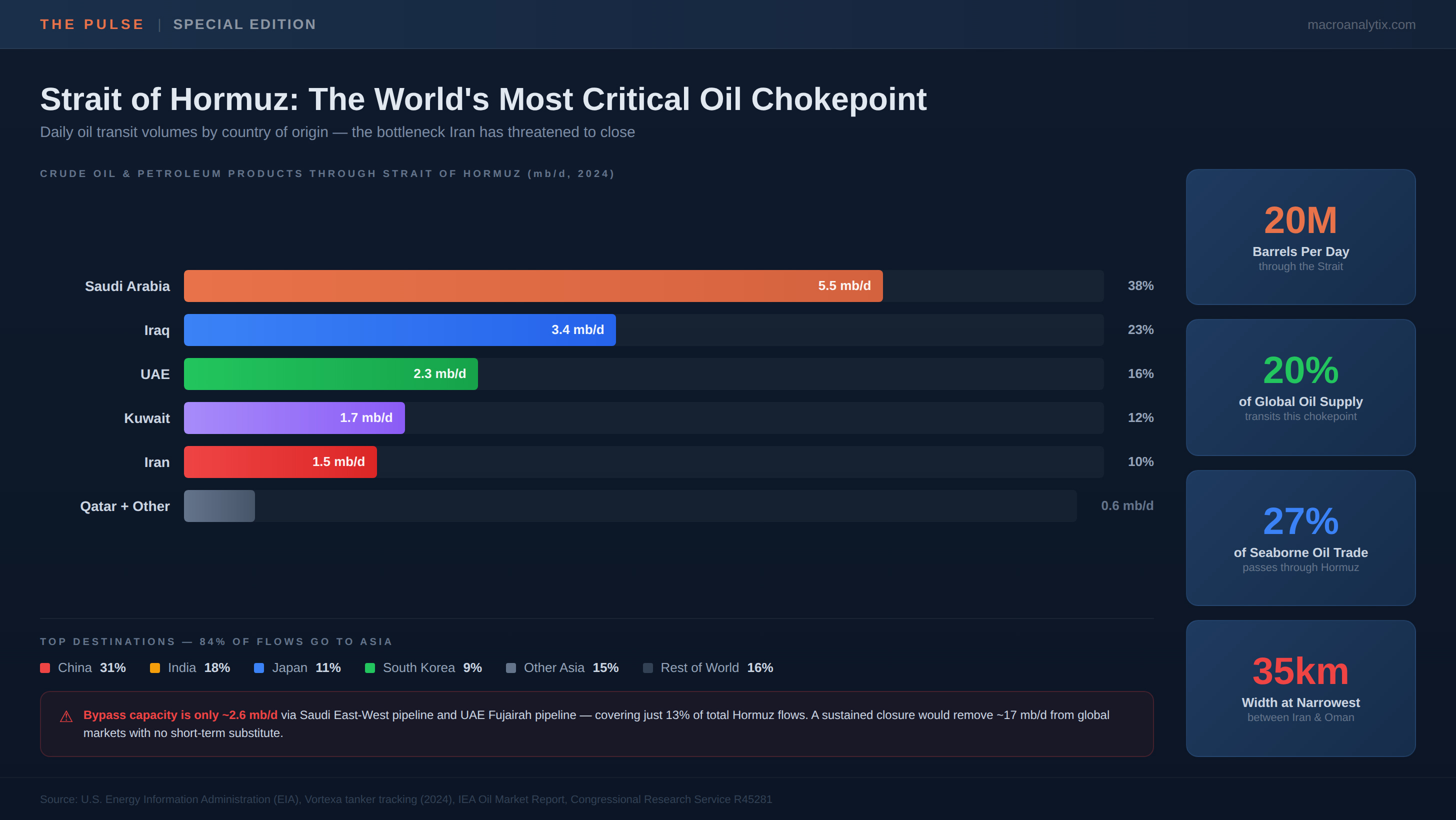
Growth (30%): Energy price shocks act as a tax on consumers and compress corporate margins. The growth deceleration we’ve been tracking doesn’t need this additional headwind. If oil sustains above $80–85, the consumer spending drag becomes material. The path from Neutral/Chop to Late Cycle just got shorter.
Policy (20%): The Fed is now trapped in a familiar bind: supply-side inflation meets demand-side weakness. Cutting rates risks stoking the inflation impulse. Holding risks choking a decelerating economy. This is the textbook definition of a stagflationary policy paralysis and it’s exactly what makes this scenario so dangerous for multi-asset portfolios.
Liquidity (10%): Flight-to-safety flows tighten financial conditions for risk assets while compressing Treasury yields. Dollar strengthens on haven demand. Funding markets could stress if the conflict escalates beyond the initial strike window, particularly if counterparty risk perceptions shift.
Risk Appetite (15%): The only pillar that was positive in last week’s scorecard is now under direct assault. Expect VIX to gap above 25. Credit spreads to widen. Equity futures to open significantly lower. Gold, Treasuries and the dollar absorb the safe haven bid. The risk-on modifier that was carrying the regime read evaporates.
Regime Trajectory
The net effect across pillars points clearly toward one outcome: the probability of a Stagflation regime has increased materially. A supply-driven inflation shock meeting a decelerating growth backdrop with a paralysed central bank, that’s the regime definition. We aren’t declaring a full regime shift yet. The duration and scale of military operations matters enormously. A contained, multi-day strike that ends with de-escalation looks very different from a sustained campaign with Iranian retaliation across the theatre.
Signposts to Watch
Strait of Hormuz: Does Iran attempt to close or mine the strait? Roughly 20% of global oil supply transits through it. Any disruption here changes the oil calculus from a risk premium to a supply crisis.
Iranian retaliation scope: Targeted missile strikes on Gulf bases (as in June 2025) vs. broader regional escalation involving Hezbollah remnants or Houthi forces. The breadth of response determines whether this stays a bilateral conflict or becomes a regional war.
Oil price levels: Brent below $80 suggests markets view this as contained. Brent above $90 signals supply disruption fears. Above $100 means we’re in regime-shift territory for Inflation.
Fed communication: Watch for emergency statements or forward guidance shifts. Any hint that the Fed is weighing the growth drag over the inflation impulse tells you which way Policy tilts.
The Bottom Line
This is the exogenous shock the framework is built to parse. The regime hasn’t shifted yet—but the probability distribution has moved dramatically. Stagflation risk is elevated. Position sizing should reflect maximum uncertainty. If you followed the signpost discipline from The Setup, you know the playbook: gold exposure benefits from haven flows, duration gets a bid from growth fears but faces inflation headwinds, and cyclical equity exposure—the regime’s prior favourite—faces the most risk from here.
Sunday’s Setup will provide a full regime reassessment once we have 24–48 hours of market reaction and clearer visibility on the scope of operations. Until then: size for uncertainty, watch the signposts, and let the framework do the work.